
What is chair yoga?
Chair yoga is yoga adapted so you can do it sitting down, or using a chair for support. It combines gentle stretching, simple movements and slow breathing. Because it needs no mat and no change of clothes, it fits into a workday: at a desk, in a meeting room or on a video call.
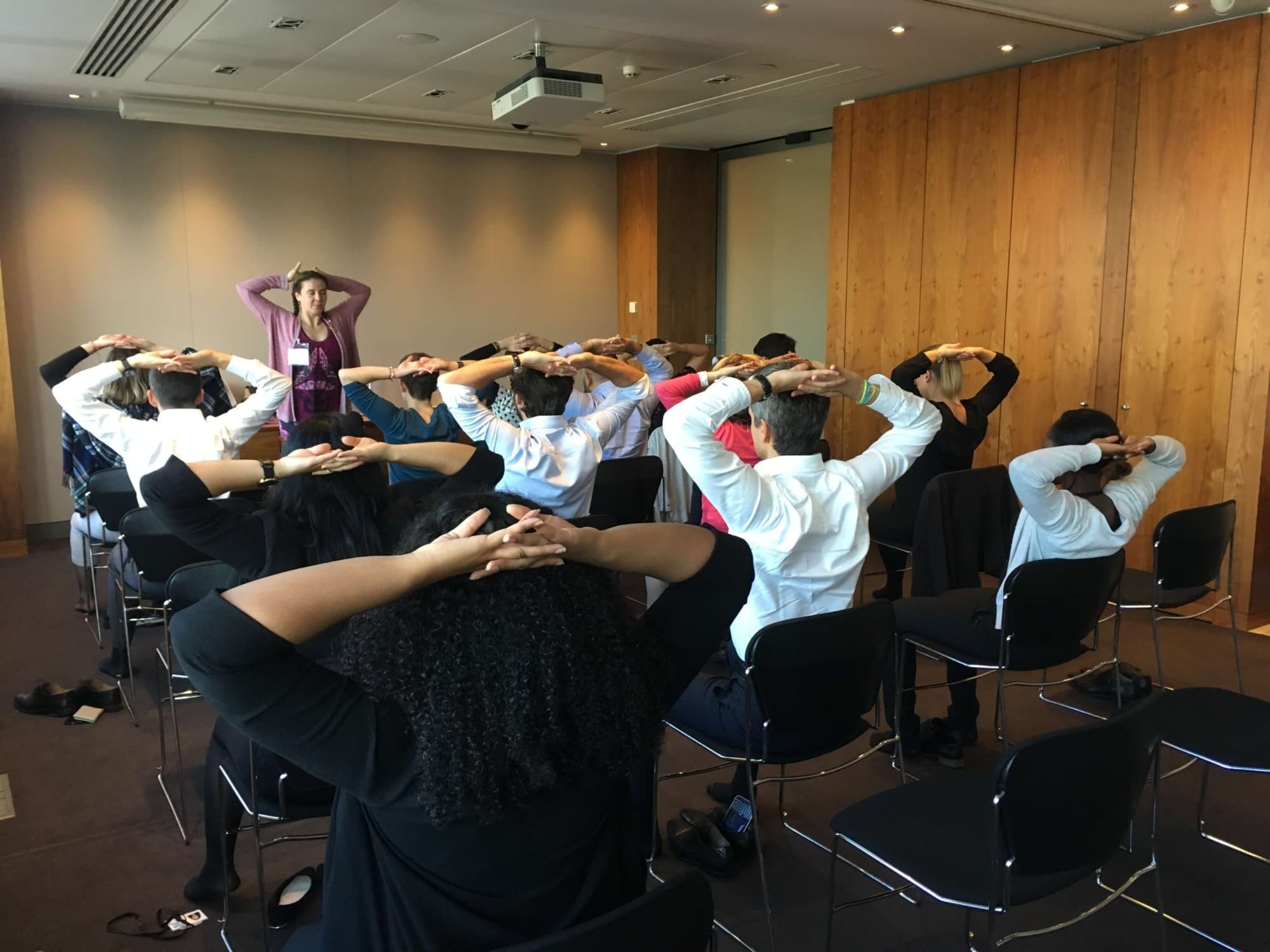
Why it works at work
Yoga and breathwork are among the best-studied workplace stress practices, and short sessions still show measurable effects:
Workplace yoga reduced perceived stress more than no intervention, with a medium-to-large effect.
10 minutes of daily yoga reduced musculoskeletal discomfort and mood disturbance in home-office workers.
For desk-based workers, yoga was linked to better psychological and physical wellbeing, lower perceived stress and less musculoskeletal discomfort.
Breathwork was linked to lower stress than control conditions.
Fincham et al., 2023, Scientific Reports: meta-analysis of randomized controlled trials
The 10-minute chair yoga routine
Move slowly and breathe through your nose if you can. Stay within a range that feels comfortable: a stretch should feel gentle, never painful.
- 01
Settle and breathe · 1 minute
- Sit toward the front of your chair, feet flat on the floor, hands resting on your thighs.
- Breathe in through your nose for a count of 4, then out slowly for a count of 6.
- Repeat for about six breaths. Let your shoulders drop a little on each exhale.
- 02
Neck release · 1 minute
- Gently tip your right ear toward your right shoulder. Keep both shoulders relaxed.
- Hold for three slow breaths, then switch sides.
- Finish by slowly lowering your chin toward your chest for two breaths.
- 03
Shoulder rolls · 1 minute
- Lift your shoulders toward your ears, roll them back and let them drop.
- Do five slow rolls backward, then five forward.
- 04
Seated cat-cow · 1 minute
- With hands on your knees, breathe in and gently arch your back, lifting your chest.
- Breathe out and round your spine, drawing your belly in and chin toward your chest.
- Move slowly with your breath for six rounds.
- 05
Side stretch · 2 minutes
- Reach your right arm overhead and lean gently to the left, keeping both hips on the chair.
- Hold for three breaths, then switch sides. Repeat once more on each side.
- 06
Seated twist · 2 minutes
- Sit tall. Place your left hand on your right knee and your right hand on the back or seat of the chair.
- Breathe in to lengthen your spine, breathe out to turn gently to the right.
- Hold for three breaths, come back to centre, then switch sides. Repeat once more on each side.
- 07
Wrist and hand reset · 1 minute
- Extend your right arm, palm up, and use your left hand to gently draw the fingers back. Hold for three breaths, then switch.
- Make loose fists and roll your wrists in circles a few times each way.
- 08
Close with breath · 1 minute
- Return to your starting position and close your eyes if you're comfortable.
- Take six slow breaths, making each exhale a little longer than the inhale.
A note on safety: skip any movement that causes pain, and keep both feet on the floor and your chair stable (avoid chairs with wheels if you can). If you have an injury, a health condition or are pregnant, check with a healthcare provider before starting a new routine.
How to make it a team habit
Lack of time is the most common reason employees skip wellness programs, so the easiest routines to keep are the ones that fit into time the team already has together.
- Pick a recurring slot that already exists, such as the start of a team meeting or a mid-afternoon break, so nobody has to find extra time.
- Keep it short. Ten minutes is enough, and short sessions are easier to protect in a busy calendar.
- Make it optional and low-pressure. No change of clothes, no mats, and cameras off is fine on video calls.
- Rotate who leads, or put the routine on a shared screen so everyone can follow along.
Want an instructor to lead it for your team?
Velora brings certified instructors to offices, events and virtual teams across Canada and the United States, in English or French.